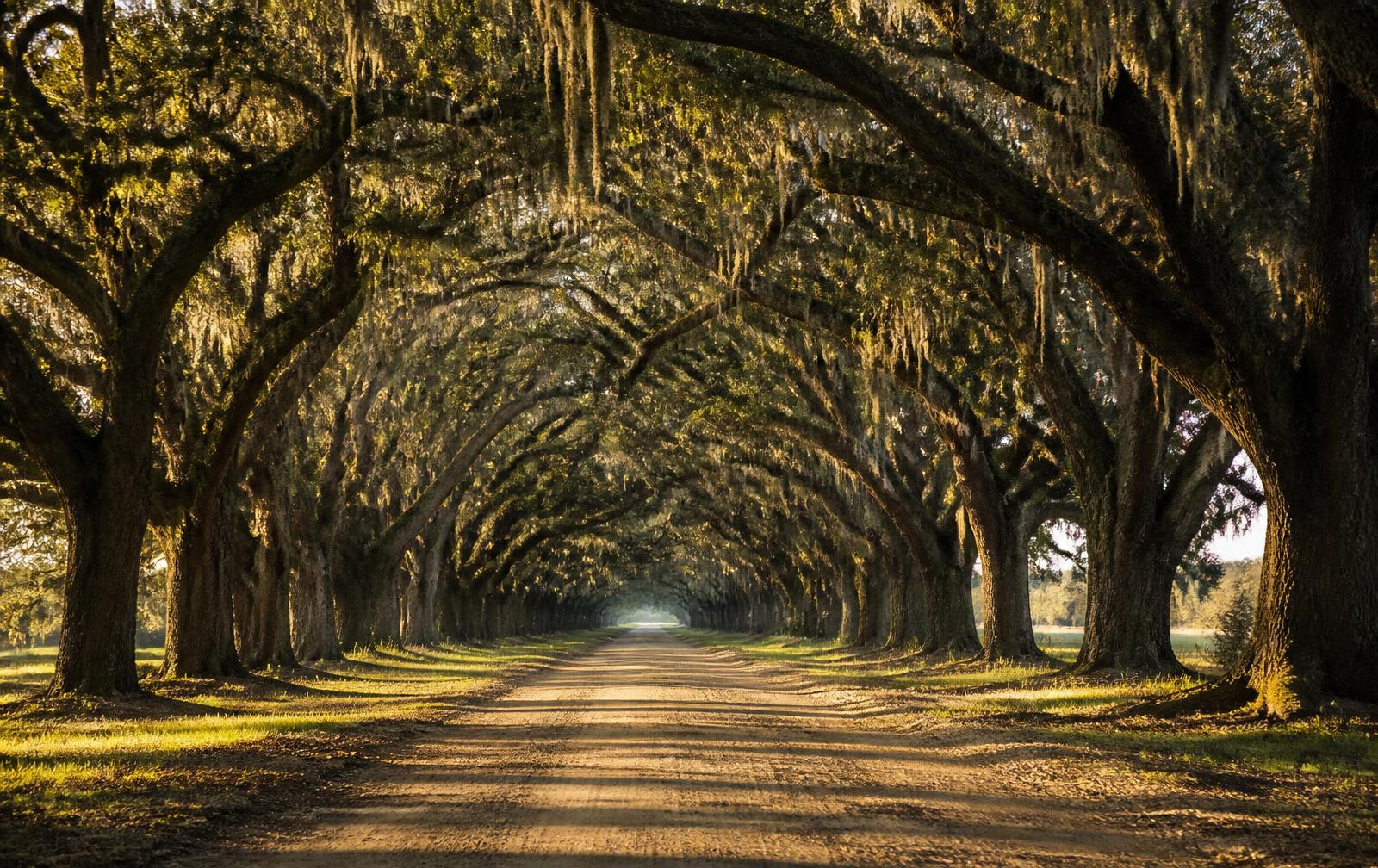
A heritage allee of century-old oaks near Quail Hollow in Charlotte

Heritage

How Quail Hollow was made.

From a George Cobb routing through Charlotte pines to a permanent fixture of championship golf.

Most prestigious American neighborhoods are built around an idea. Quail Hollow was built around a golf course — and then, over six decades, the golf course grew into something the neighborhood could not have predicted.

This is an independent editorial account of that arc: the design, the tournaments, the renovations, and the way each shaped the residential corridor that carries the name.

Late 1950s

A course in the pines

Quail Hollow Club opens on rolling, wooded land in what was then the southern edge of Charlotte. George Cobb — a Southern architect known for routing that follows terrain rather than fighting it — lays out a course through creeks and hardwoods. The land, not the ambition, defines the early character.

1960s–1970s

The neighborhood forms

Homes rise around the course in the era's prevailing traditional idiom, on lots sized to preserve canopy. The corridor establishes the pattern it still holds: deep setbacks, mature hardwoods, brick and stone, and almost no through traffic.

1969–1979

The Kemper Open years

Charlotte gets its first sustained taste of tour golf. The championship stage proves the course can hold professional fields — and plants the institutional memory the club would later draw on.

1980s–1990s

Quiet accumulation

Without a permanent tour event, the club deepens as a member institution and the neighborhood matures. Substantial traditional construction fills remaining lots, and the corridor's reputation within Charlotte solidifies well ahead of any national profile.

2003 onward

Charlotte's annual stop

The PGA Tour returns to Quail Hollow for good. The event becomes a fixture of the spring schedule, the closing stretch earns the name the Green Mile, and the neighborhood becomes a familiar backdrop on international broadcasts.

2010s

The Fazio reshaping

Tom Fazio leads a series of renovations — most consequentially a reworking of the opening holes and a comprehensive rebuild of greens and surfaces. The course gets longer, firmer, and materially harder without losing Cobb's routing logic.

2017 & 2022

Major championship status

The PGA Championship arrives, followed by the Presidents Cup. Quail Hollow moves from a strong tour stop to a venue in the permanent rotation of consequential championship golf — and the address around it changes value accordingly.

Today

A renovation cycle, not a build cycle

There is effectively no raw land left. The corridor's activity now is renovation, selective rebuilding, and quiet off-market transfer. Inventory is thin, turnover is low, and the neighborhood's character is maintained by owners rather than developers.

Why the history matters to buyers

Neighborhood values in Charlotte are usually a function of school assignment, commute, and inventory. Quail Hollow has a fourth input almost no other address in the city can claim: a permanent, internationally recognized institution at its center. That is durable in a way amenities are not. Courses of this stature are not built anymore in established cities, and the land around them is not replicated.

The practical consequence is scarcity. A finite number of homes sit inside a corridor whose profile keeps rising, in a market where owners tend to stay for decades.

A dated timeline

The milestones that moved Quail Hollow from a members' course in the pines to a permanent fixture of major championship golf.

1959
Quail Hollow Club is organized by Charlotte businessman James J. Harris on rolling, wooded land south of the city.
1961
The George Cobb course opens for play. Cobb routes the holes through existing creeks and hardwood stands rather than reshaping the land.
1969
The Kemper Open arrives, giving Charlotte its first sustained PGA Tour presence.
1979
The Kemper Open plays its final Quail Hollow edition before relocating to the Washington, D.C. area.
1986
Arnold Palmer's design group carries out the first significant revision of the Cobb layout.
1997
Tom Fazio begins a multi-decade relationship with the club, starting a sequence of renovations that continues today.
2003
Tour golf returns permanently as the Wachovia Championship. David Toms wins the inaugural playing.
2009
The event is renamed the Quail Hollow Championship after Wachovia's sale.
2011
The tournament becomes the Wells Fargo Championship, the name it carries for more than a decade.
2013
Fazio rebuilds the putting surfaces, converting the greens to Bermuda and materially changing how the course plays in May heat.
2016
The opening sequence is rebuilt ahead of the PGA Championship: the old 1st and 2nd are combined into a longer par 4 and a new par 3 is created.
2017
The PGA Championship comes to Quail Hollow. Justin Thomas wins at 8 under par.
2020
The tournament is cancelled during the pandemic season — the only missed year since 2003.
2022
The Presidents Cup is staged at Quail Hollow. The United States wins 17.5–12.5.
2025
The club hosts its second PGA Championship. Scottie Scheffler wins at 11 under par.
2026
The Truist Championship is scheduled to return to Quail Hollow after a one-year move to Philadelphia during the PGA year.
2034
The PGA of America has awarded Quail Hollow a third PGA Championship, confirming the club's place in the long-term major rotation.

Every champion since tour golf returned

Twenty-two playings between 2003 and 2025, including two PGA Championships. Rory McIlroy's four victories here — 2010, 2015, 2021 and 2024 — are the most by any player at the venue, and his closing 61 in 2015 remains the competitive course record. He also opened his 2010 win with a final-round 62.

PGA Tour and major champions at Quail Hollow Club, 2003–2025
YearChampionEvent
2003David TomsWachovia Championship
2004Joey SindelarWachovia Championship
2005Vijay SinghWachovia Championship
2006Jim FurykWachovia Championship
2007Tiger WoodsWachovia Championship
2008Anthony KimWachovia Championship
2009Sean O'HairQuail Hollow Championship
2010Rory McIlroyQuail Hollow Championship
2011Lucas GloverWells Fargo Championship
2012Rickie FowlerWells Fargo Championship
2013Derek ErnstWells Fargo Championship
2014J.B. HolmesWells Fargo Championship
2015Rory McIlroyWells Fargo Championship
2016James HahnWells Fargo Championship
2017Justin ThomasPGA Championship
2018Jason DayWells Fargo Championship
2019Max HomaWells Fargo Championship
2021Rory McIlroyWells Fargo Championship
2022Max HomaWells Fargo Championship
2023Wyndham ClarkWells Fargo Championship
2024Rory McIlroyWells Fargo Championship
2025Scottie SchefflerPGA Championship

The 2020 edition was cancelled during the pandemic season, and the 2025 Truist Championship was played in Philadelphia because Quail Hollow was preparing to host the PGA Championship that May.

Three architects, one routing

The course has been revised repeatedly without ever being replaced. That continuity is the reason the modern championship layout still walks like the 1961 original.

1959–1961

George Cobb

Original routing. A Southern architect whose signature was restraint — holes shaped to the terrain, greens sited where the land already fell away. The bones of today's course are still his.

1986

Arnold Palmer Design

The first substantial revision, modernizing bunkering and lengthening a course built for persimmon woods and balata golf balls.

1997–present

Tom Fazio

A continuing relationship rather than a single project: bunker reconstruction, tee extension, green rebuilds in 2013, and the 2016 reconfiguration of the opening holes that produced the current championship sequence.

How the houses followed the course

The residential corridor was not master-planned in one pass. It accumulated in four distinct waves, and you can still read all four from the car.

1961–1975Original construction
One- and two-story brick traditionals and ranch-influenced plans on the earliest streets nearest the club. Modest by current standards — often 3,000 to 4,500 sq ft — on lots that are now the corridor's most valuable asset.
1976–1995The infill decades
Larger Georgian and Colonial Revival houses fill remaining lots. Ceiling heights rise, formal rooms proliferate, and the two-story brick façade becomes the corridor's default language.
1996–2010The estate era
French country and transitional estates on the deepest lots, frequently 6,000 sq ft and up, with the first serious outdoor living programs — loggias, pool houses, and summer kitchens.
2011–todayRenovation and replacement
Raw land is gone. Activity is gut renovation, rear additions, and selective teardown-rebuild on lots where the land value has outrun the house on it.

Four things people get wrong

The neighborhood is not the club. Quail Hollow the residential corridor and Quail Hollow Club are separate entities. Buying a house on the course conveys no membership, no playing privileges, and no standing with the club.

There is no single Quail Hollow HOA. The original neighborhood has no community-wide association governing the whole corridor. Some newer enclaves inside it — gated communities built in later decades — do have their own associations and design review, which is why rules vary street to street.

The Green Mile is not original. The closing stretch earned its reputation only after tour golf returned in 2003 and the modern lengthening took hold. For the Kemper Open era, the finish was hard but unnamed.

The tournament has changed names four times. Wachovia, Quail Hollow Championship, Wells Fargo, and now Truist all describe the same May event. Historical results are frequently mis-filed because of it.

Questions & Answers

Frequently asked questions

Direct answers to what readers most often ask about this section of the guide. Each answer cites the primary source it rests on.

All Quail Hollow questions →

When was Quail Hollow Club founded?

+

Quail Hollow Club opened at the end of the 1950s on land in what was then Charlotte's southern edge, with an original design by George Cobb. The surrounding residential neighborhood grew alongside it through the 1960s and 1970s.

Source: Quail Hollow Club

Which major championships has Quail Hollow hosted?

+

Quail Hollow hosted the PGA Championship in 2017 and again in 2025, the Presidents Cup in 2022, and has staged a PGA TOUR event annually since 2003 under several title sponsors, currently the Truist Championship.

Source: PGA Championship official site

Who redesigned the course?

+

George Cobb designed the original course, Arnold Palmer's firm carried out significant later work, and Tom Fazio led the modern renovations that shaped the course into its current championship configuration.

Source: USGA course and handicap resources

How did the neighborhood develop around the club?

+

Development came in waves: the original 1960s ranch and split-level streets, a 1980s traditional brick expansion, 1990s–2000s estate infill, and the post-2010 teardown-and-rebuild cycle still underway today.

Source: City of Charlotte Unified Development Ordinance (2023)

Our Sources

How this page was researched

This guide is independently written and verified against primary public records and official organizations. It is not affiliated with, endorsed by, or representing the Quail Hollow Club, any HOA, developer, or governing body.

Read our full citation methodology and editorial standards
  1. 01
    Local history collections and archives

    Charlotte Mecklenburg Library — Robinson-Spangler Carolina Room

    Historical record of the club and surrounding development.

  2. 02
    Quail Hollow Club — official site

    Quail Hollow Club

    Course details, club history, and tournament hosting.

  3. 03
    PGA Championship — championship history and venues

    PGA of America

    Championship dates, venue records, and results.

  4. 04
    POLARIS 3G property and parcel records

    Mecklenburg County GIS

    Parcel boundaries, lot sizes, ownership, and sale history.

Figures such as pricing, assessments, and school assignment change over time. Always confirm current details directly with the source before making a decision.

Editorial Accuracy

Submit a correction

This page is independently written and fact-checked against primary sources. If a detail is outdated or inaccurate, send it with a citation and it will be reviewed against the record.

Review status
Reviewed & verified
Last editorial review
Review cadence
Quarterly
Page reference
/history

Corrections are reviewed by the editorial team against primary sources before any change is published. Submissions are sent only to the site editor.

Topic Cluster

Quail Hollow Background & Answers

How the community was made, and the questions buyers ask most.

The Quail Hollow Guide — Quail Hollow Background & Answers
Quail Hollow monogram
Quail Hollow

Charlotte · North Carolina

The definitive independent guide to Quail Hollow — Charlotte's legendary golf community. Estates, championship golf, timeless architecture, and exceptional Southern living.

Trusted Local Resources

An independent editorial guide. Not affiliated with, endorsed by, or representing Quail Hollow Club or its HOA.

Legal

Important notice. quailhollowcharlotte.com is an independent editorial guide. It is not the Quail Hollow homeowners association, not a community or property owners' association, and not the Quail Hollow Club, and it is not affiliated with, endorsed by, sponsored by, or officially connected to any association, club, developer, brokerage, school district, tournament, or governmental body. All third-party names and marks belong to their owners and are used for identification and commentary only. Content is provided for general informational purposes on an "as is" basis, is researched in good faith but may contain errors or become outdated, and is not legal, tax, financial, appraisal, or real estate advice and not an offer to sell or a solicitation to buy any property. Verify all information independently with the responsible authority before relying on it. Use of this site is governed by our Terms of Use, which include a disclaimer of warranties, limitation of liability, and binding arbitration. Equal Housing Opportunity.

Advertising disclosure. This site contains paid, sponsored, affiliate, and referral relationships. The local firms named here are affiliated with or compensate the publisher, and inquiries submitted through any form may result in a commercial engagement. Compensation never buys placement in editorial rankings or the removal of accurate information. Full details in our Advertising & Affiliate Disclosure.

© 2024–2026 Discover Quail Hollow (quailhollowcharlotte.com). All rights reserved.

Copyright is claimed in all original text, editorial analysis, photography, illustrations, maps, data compilations, page design, code, and the selection and arrangement of this site as a collective work under 17 U.S.C. §§ 101 et seq. and international treaties. Reproduction, republication, syndication, scraping, or use for training or grounding machine-learning or generative AI systems is prohibited without prior written permission; all text- and data-mining rights are expressly reserved. Brief quotation with attribution and a live link to the source page is permitted. Third-party names and marks belong to their owners. Copyright, licensing, and takedown notices: npeters@yourleaderinluxury.com.

Charlotte's Legendary Golf Community